
Have you ever watched your child start something with excitement, only to hear, “I can’t do this,” when the first challenge appears? Maybe they are working on a difficult school assignment, learning a new sport, solving a puzzle, or trying to master a new skill. At first, everything seems exciting. But when the task becomes harder, they may put it aside and decide they don’t want to continue.
If you’ve been asking, “Why does my child give up when things get difficult?”, try to understand what’s behind the behaviour, not just what you see.
Giving up doesn’t always mean a child is lazy or unwilling to work. Sometimes, they simply haven’t yet learned how to handle frustration, mistakes, disappointment, or the feeling of not being successful right away.
Children develop perseverance gradually. They need opportunities to experience challenges in a supportive environment where mistakes are treated as part of learning. When adults guide them patiently instead of expecting perfection, children can slowly develop the confidence to keep going.
One useful way to encourage this mindset is through activities that allow children to practise, make mistakes, receive guidance, and experience gradual progress. Martial arts can provide exactly this type of learning experience.
Why Does My Child Give Up When Things Get Difficult?
There isn’t one answer that applies to every child. Children give up for different reasons, and understanding those reasons can help parents respond more effectively.
Some children have very high expectations of themselves. They may believe that being good at something means getting it right immediately. When they make a mistake, they become frustrated because their experience doesn’t match what they expected.
Others may have experienced repeated difficulty in school or other activities. After struggling several times, they may start believing that they simply cannot succeed. Saying “I can’t do it” can become easier than risking another disappointment.
Fear of failure is another common reason. A child may worry about looking foolish, being corrected, losing a game, or disappointing someone they care about.
Sometimes, the task itself may be too difficult for their current ability. If a child doesn’t know where to begin, the challenge can feel overwhelming.
Asking why your child gives up when things get difficult can help you understand the underlying reason rather than reacting with criticism.
Fear of Failure Can Make Children Stop Trying
Failure can feel much bigger to a child than it does to an adult.
Imagine a child trying something several times and still not getting it right. They may begin thinking, “I’m not good at this.” If they connect mistakes with being unsuccessful, they may choose not to try at all.
Parents can help change this thinking by making mistakes feel normal.
Instead of focusing on what went wrong, talk about what the child learned. Encourage them to think about what they could try differently next time. This helps them understand that one unsuccessful attempt doesn’t determine the final result.
When children learn that mistakes are temporary, they become more willing to take another step.
Understanding why does my child give up when things get difficult also means recognising that a child may be protecting themselves from disappointment rather than simply refusing to cooperate.
Teach Children That Progress Takes Time, Patience, and Practice
In today’s world, children see quick results everywhere. Games provide instant rewards, videos load within seconds, and many digital activities are designed to keep things moving.
Real learning is different.
Learning to swim, read, play an instrument, solve complicated maths problems, or develop a physical skill can take weeks, months, or even years.
Children need to experience the satisfaction that comes from gradual improvement.
When they practise something difficult and eventually notice a small improvement, they begin to understand that effort has value.
This is an important answer to why does my child give up when things get difficult. Sometimes children simply haven’t had enough opportunities to experience the connection between persistence and progress.
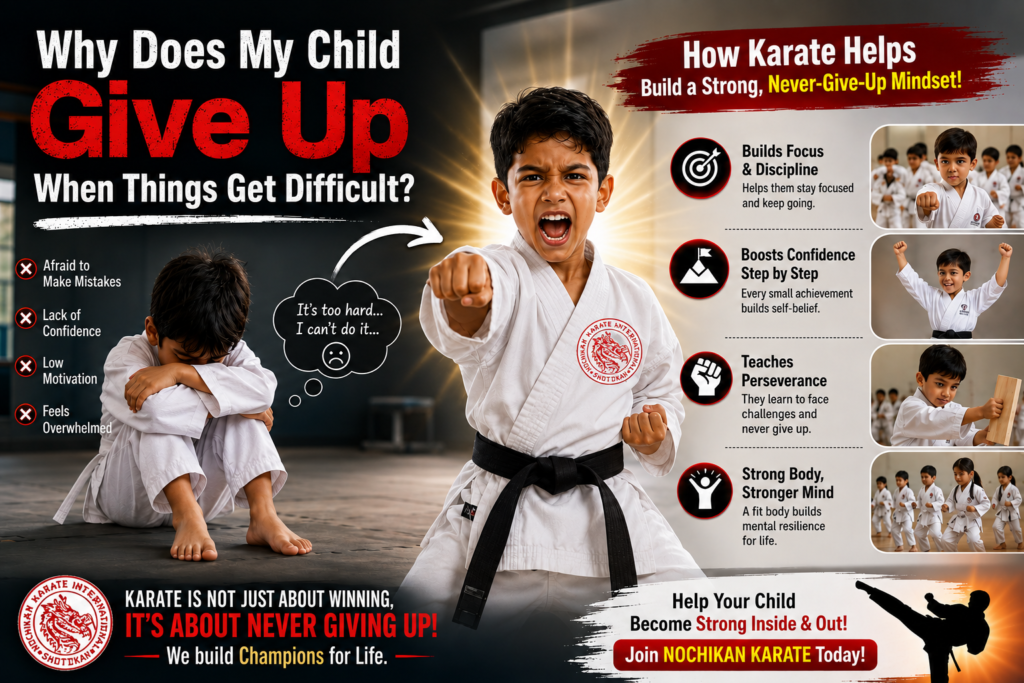
How Karate Helps Children Keep Trying
Karate gives children regular opportunities to face challenges and overcome them at their own pace.
A new movement may not feel natural at first. Children may find it challenging to remember things in the correct order. A technique may require repeated practice before a child feels comfortable performing it.
Instead of expecting children to master everything immediately, instructors can break skills into smaller steps.
Children practise one part, receive feedback, make adjustments, and try again.
This repeated process can teach an important lesson:
Progress Matters More Than Perfection
For children who frequently ask themselves why does my child give up when things get difficult, a structured activity like karate can provide practical experiences that show them how persistence works.
Small Achievements Can Create a Stronger Mindset
Children don’t always need huge achievements to feel motivated.
A small improvement can be meaningful.
Maybe a child couldn’t remember a movement during their first few classes but eventually performs it correctly. Perhaps they struggled with a particular technique but later manage it without assistance.
These moments show children that their effort matters.
Gradual progress can also make large goals feel less intimidating. Instead of thinking about everything they need to learn, children can concentrate on the next achievable step.
This approach can help answer why does my child give up when things get difficult by changing the child’s relationship with difficulty itself.
A challenge becomes something to work through rather than something to escape.
Discipline Helps Children Continue When Motivation Changes
Motivation can disappear quickly.
A child might be excited about an activity one week and less interested the next. This is normal.
Discipline helps children continue working toward a goal even when they aren’t feeling highly motivated.
Regular karate training can introduce children to routines that encourage consistency. They learn to arrive prepared, listen to instructions, practise skills, and work towardgradual improvement.
This doesn’t meanchildren should be pushedrelentlessly.Restandenjoymentare important too.
The goalis to help children understand that meaningful progress usually comes from consistent effort rather than waiting until they feel motivated.
What Should Parents Say When a Child Wants to Quit?
The words parents use during difficult moments can have a lasting effect.
When your child says, “I can’t do it,” avoid immediately saying, “Yes, you can!” Although well-intentioned, the child may feel that their frustration isn’t being understood.
Instead, acknowledge the difficulty first.
You could say:
“I can see that this is frustrating.”
“Which part is giving you trouble?”
“Let’s figure out the next small step.”
“You don’t have to finish everything right now. Let’s try one part.”
These responses help children feel supported while still encouraging them to continue.
If you are repeatedly wondering why does my child give up when things get difficult, pay attention to what happens immediately before they quit. Understanding the trigger can make your response more effective.
Avoid Comparing Your Child With Others
Comparison can make challenges feel even harder.
If a child sees another student learning faster, they may assume that something is wrong with them. Statements such as “Why can’t you do it like your friend?” can increase frustration and reduce motivation.
Every child develops at a different pace.
Instead of comparing your child’s progress with someone else’s, compare their current ability with where they started.
You can say:
“Last month you found this difficult, but look at what you can do now.”
This encourages children to notice their own progress.
It also provides a healthier answer to why does my child give up when things get difficult: they may need to recognise that improvement is personal and doesn’t have to happen at someone else’s speed.
The Role of Instructors in Building Perseverance
A positive instructor can make difficult learning experiences much easier for children.
Children need clear explanations, reasonable expectations, and encouragement when something doesn’t go according to plan.
A good instructor doesn’t simply tell a child to try harder. They help identify what is going wrong and show the student how to improve.
This approach can make a child feel capable instead of defeated.
At Nochikan Karate International, a structured and supportive learning environment can give children opportunities to practise discipline, perseverance, respect, and patience while developing their martial arts skills.
How Parents Can Build Perseverance at Home
Parents don’t need to create difficult challenges just to make children persistent. Everyday activities can provide opportunities to practise.
Let your child attempt age-appropriate tasks independently before stepping in to help.
If they are solving a puzzle, give them time to think. If they’re struggling with homework, ask which part they understand rather than immediately giving them the answer.
You can also break large responsibilities into smaller steps.
For example, instead of saying, “Clean your entire room,” you might say:
- Put your books away.
- Put your clothes in the laundry basket.
- Organise your toys.
Completing small steps gives children a sense of progress.
These everyday experiences can help answer why does my child give up when things get difficult by showing them that difficult tasks can become manageable when approached one step at a time.
Encourage Effort Instead of Natural Ability
Children often hear phrases such as “You’re very talented.” While compliments can be positive, focusing too much on natural ability may unintentionally make children afraid of difficult tasks.
If they believe they are supposed to be naturally good at something, struggling can feel like proof that they aren’t talented after all.
Instead, praise the process.
Say:
- “You kept practising.”
- “You didn’t give up after the first mistake.”
- “You found another way to solve it.”
- “You improved because you kept working.”
This teaches children that their actions can influence their progress.
It is another useful way of addressing why does my child give up when things get difficult because the focus shifts from “Am I good at this?” to “What can I do to improve?”
Signs Your Child Is Becoming More Persistent
Perseverance develops slowly, so don’t expect an overnight change.
You may begin noticing small signs such as your child trying again after a mistake, asking for help instead of quitting, or spending longer on a challenging task.
Other signs may include:
- Greater patience
- Less frustration
- More willingness to practise
- Better problem-solving
- Greater independence
- More positive self-talk
- Willingness to try unfamiliar activities
- Finishing tasks more consistently
These changes can happen gradually as children gain more positive experiences with challenges.
When Giving Up Becomes a Pattern
Occasionally wanting to stop an activity is normal. Children may be tired, overwhelmed, or simply no longer interested.
However, if a child consistently avoids challenges across many areas of life, parents may want to look more closely at what is happening.
Notice whether the child becomes extremely upset whenever they make a mistake, avoids activities because of fear, or regularly believes they cannot succeed.
In such situations, talking with the child’s teacher or another appropriate professional may provide useful insight.
The aim isn’t to label the child. It’s to understand what they need and provide the right support.
Building a “Try Again” Attitude
One of the most valuable lessons children can learn is that they don’t have to succeed immediately.
They can pause.
They can ask for help.
They can practise.
They can make mistakes.
And they can try again.
When children experience this process repeatedly, difficult situations may begin to feel less intimidating.
The question why does my child give up when things get difficult then becomes an opportunity to teach an important life skill: perseverance.
Children don’t need to enjoy every challenge. They simply need to learn that difficulty is not always a reason to stop.
Conclusion
If you’ve been asking, why does my child give up when things get difficult, remember that giving up is often connected to frustration, fear of failure, unrealistic expectations, or simply not knowing how to approach a challenge.
Children can learn perseverance through small goals, consistent practice, supportive adults, and positive experiences with difficulty. Activities such as karate can give them practical opportunities to practise skills, overcome setbacks, and see their own improvement.
The goal isn’t to make children push through every situation without rest. It’s to help them recognise when something is difficult and understand that difficulty doesn’t automatically mean they are incapable.
With patience and encouragement, a child who once said “I can’t do this” can gradually learn to say:
“I’ll try again.”
