

If you’ve ever wondered, “Why Does My Child Lose Focus During Activities?”, you’re certainly not alone. Many parents notice that their child starts homework, a game, drawing, reading, or another activity with enthusiasm but soon becomes distracted. They may look around the room, start talking, leave the task unfinished, or suddenly want to do something completely different.
This can be frustrating, especially when it happens regularly. However, losing focus doesn’t automatically mean that a child is lazy or unwilling to learn. Children are still developing their ability to concentrate, manage distractions, and stay with a task when it becomes challenging.
The good news is that concentration is a skill that can improve with practice. The right activities, supportive routines, encouragement, and opportunities to stay mentally engaged can gradually help children become more attentive.
If you’re still wondering, “Why does my child lose focus during activities?”, it may help to look at how long your child is expected to concentrate on one task.
Why Does My Child Lose Focus During Activities?
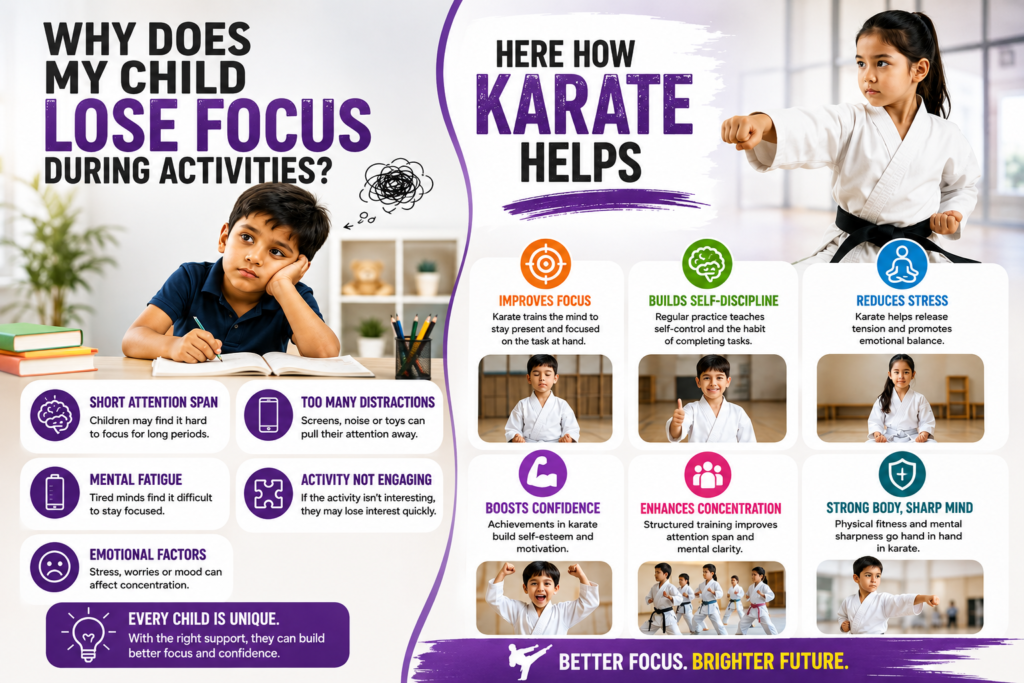
There isn’t always one simple explanation. Children can lose concentration for different reasons depending on their age, personality, surroundings, and the activity they’re doing.
Sometimes the task may feel boring. At other times, it may be too difficult or confusing. A child who doesn’t understand what to do next may quickly become distracted rather than asking for help.
The environment can also have a major effect. Television, mobile phones, background noise, toys, conversations, and frequent interruptions can make it difficult for children to stay focused on one thing.
Tiredness and hunger can affect attention too. If a child is exhausted after a busy day, expecting them to concentrate for a long period may be unrealistic.
Understanding the possible reason behind the behaviour is more useful than simply telling a child to “pay attention.”
Understanding why does my child lose focus during activities can help parents respond with patience rather than frustration.
Understanding Your Child’s Attention Span
Children don’t have the same attention span as adults. Younger children, in particular, may need shorter activities and regular opportunities to move around.
Expecting a child to sit still and concentrate for a long period can sometimes create unnecessary frustration. Instead, parents can gradually increase the amount of time children spend on activities that require concentration.
For example, a child may begin with a short reading session, a simple puzzle, or a focused drawing activity. As they become more comfortable, the duration can slowly increase.
The goal is progress rather than perfection.
How Does Losing Focus Affect Everyday Life?
Concentration plays an important role in many areas of childhood. At school, children need to listen to teachers, remember instructions, complete assignments, and understand new concepts.
At home, they need to follow routines, finish simple responsibilities, and listen when parents explain something.
When attention is inconsistent, even simple tasks can take longer. Children may need repeated reminders or become frustrated because they haven’t completed what they started.
This is why helping children develop concentration early can be valuable. Better focus isn’t only about getting better grades. It can also help children become more organised, patient, and independent.
Understanding “Why does my child lose focus during activities?” can help parents recognise whether distractions, tiredness, or difficulty with a task may be affecting concentration.
How Does Karate Help Children Improve Focus?
A structured physical activity can give children a different way to practise concentration. During karate classes, children need to pay attention to their instructor, remember movements, follow sequences, and respond at the right time.
Unlike an activity where a child can easily switch between tasks, martial arts require active participation. Children need to watch, listen, remember, and move.
This combination of physical activity and mental attention can make concentration more engaging for children who struggle to stay interested in traditional learning environments.
Listening Is an Important Part of Concentration
Good focus begins with listening. Children need to understand an instruction before they can complete it correctly.
During training, an instructor may demonstrate a movement and then ask students to repeat it. Children have to watch carefully, remember the details, and apply what they have seen.
If they miss an instruction, they may need to observe again and try once more.
Repeated experiences like these can encourage children to become more attentive listeners. Over time, the habit of listening carefully can also become useful in classrooms, conversations, and everyday situations.
If you’re wondering Why does my child lose focus during activities , paying attention to how they listen can provide useful clues.
Learning to Stay With a Difficult Task
One of the biggest challenges for children who become distracted easily is staying with an activity when it stops being easy.
A child may happily begin a puzzle but walk away when it becomes difficult. They may start learning something new but lose interest when they make a mistake.
Karate training can introduce a different approach. Children learn that new movements may take several attempts before they feel natural. They are encouraged to practise, adjust, and try again.
This teaches an important lesson: difficulty doesn’t always mean that something should be abandoned.
Understanding why does my child lose focus during activities becomes especially important when a child loses interest as soon as something becomes difficult.
Making Focus More Enjoyable
Children are more likely to concentrate when they are actively involved. Sitting quietly for a long period isn’t the only way to develop attention.
Parents can introduce activities that require children to think and respond. Puzzles, memory games, building activities, drawing challenges, reading, sports, and movement-based exercises can all provide opportunities to practise concentration.
The key is to find activities that are appropriate for the child’s age and interests.
When children enjoy what they are doing, staying engaged often becomes easier.
The Importance of a Structured Environment
A predictable routine can make concentration easier. When children know what to expect, they don’t have to constantly adjust to new instructions or unexpected changes.
A structured learning environment can also teach children when it is time to listen, practise, take a break, and complete a task.
This is one reason a consistent activity can be useful for children who struggle with attention. Regular participation allows them to become familiar with expectations and gradually build better habits.
A supportive environment should still allow children to make mistakes. The aim is to guide them rather than make them afraid of getting something wrong.
A consistent routine can help parents understand Why Does My Child Lose Focus During Activities and identify situations where distractions are most common.
How Parents Can Encourage Better Focus at Home
Parents don’t need complicated techniques to support concentration. Small changes in everyday routines can make a difference.
Start by reducing unnecessary distractions during important tasks. Ifyour child is doing homework, keep television and unrelated devices away when possible.
Give one or two instructions at a time rather than giving a long list. Ask your child to repeat the instruction if necessary.
Break larger tasks into smaller steps. Completing one manageable step can feel much easier than looking at a large task all at once.
It is also important to notice positive behaviour. If your child stays focused longer than usual, acknowledge the effort.
Instead of saying, “You finally paid attention,” try something like, “I noticed you stayed with that activity until you finished it.”
Positive feedback can encourage children to repeat the behaviour.
When Does My Child Lose Focus During Activities the Most?
Parents may find it helpful to observe when concentration problems happen most often.
Does your child lose focus mainly during homework? Does it happen when they are tired? Are they easily distracted in noisy environments? Do they struggle more with activities they don’t enjoy?
Looking for patterns can help you understand what may be affecting their attention.
For example, a child who concentrates well during an enjoyable activity but struggles with long written tasks may simply need shorter work periods and regular breaks.
Observation can help parents respond to the actual situation instead of assuming that every attention problem has the same cause.
How Instructors Can Support Children
A good instructor understands that every child develops differently. Some children may immediately follow instructions, while others need additional demonstrations or reminders.
Instructors can help by breaking skills into manageable steps and keeping children actively involved. Encouragement can also make children more willing to keep trying when they find something difficult.
In a structured martial arts environment, children can gradually become comfortable with listening, practising, repeating, and improving.
For families interested in international karate training, choosing a programme with a positive learning environment and appropriate instruction can help make the experience more enjoyable for children.
Signs Your Child’s Focus Is Improving
Progress may not always be obvious at first. Look for small changes rather than expecting an instant transformation.
Your child may begin to:
- Listen without needing repeated reminders
- Complete activities more consistently
- Follow instructions more accurately
- Spend longer on challenging tasks
- Remember sequences more easily
- Become less distracted by their surroundings
- Show greater patience
- Finish tasks they previously abandoned
These small improvements can build over time.
The aim isn’t to make a child concentrate every minute of the day. Children still need time to play, relax, explore, and be creative.
When Should Parents Seek Additional Support?
Occasional distraction is a normal part of childhood. However, if concentration difficulties are persistent and significantly interfere with school, relationships, daily routines, or other areas of life, parents may want to discuss their concerns with the child’s teacher or a qualified professional.
It is important not to label a child as careless or lazy simply because they struggle with attention. Understanding the situation and getting appropriate guidance can be much more helpful.
Every child develops differently, and support should be based on their individual needs.
Conclusion
If you’re still asking, “Why Does My Child Lose Focus During Activities?”, remember that concentration develops gradually. Children may need engaging activities, consistent routines, clear instructions, movement, encouragement, and plenty of opportunities to practise staying attentive.
Karate can be one useful way to support this development because children are encouraged to listen, remember movements, follow instructions, and stay engaged while learning new skills.
With patience and consistent support, small improvements can become lasting habits. Rather than expecting children to focus perfectly, parents can help them discover that concentration is something they can practise, strengthen, and improve over time.
